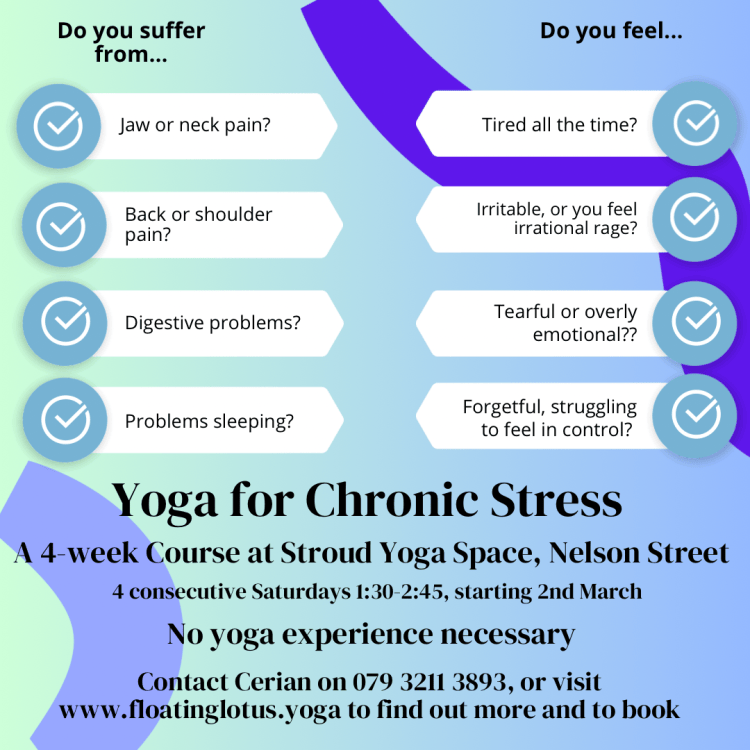
My history of mental health struggles has a long and fairly complicated story to it, but the episodes I’ve had of acute mental health problems have had some things in common:
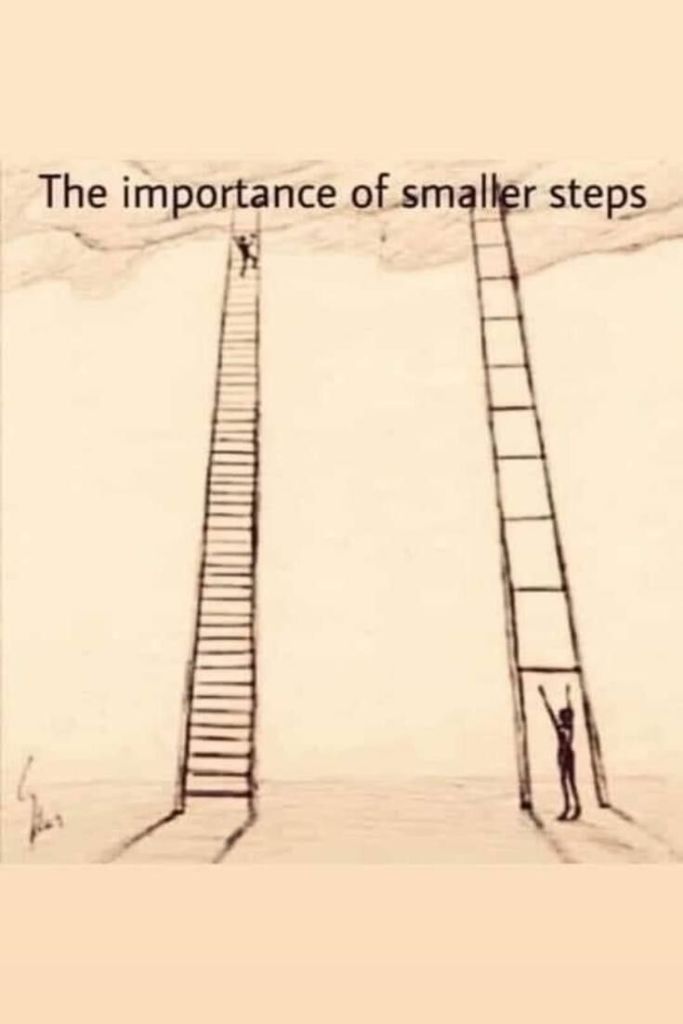
- Too many tasks and not enough rest
- Negative self-talk and rumination on my failings and my problems
- Attachment to the final outcome, meaning that the task seemed insurmountable
I was in a state of overwhelm, where I couldn’t see how to achieve all that I needed to at the standard required. My stress response had become chronic, so rather than being a useful system to activate me and allow me to complete my jobs, it had flooded me and I wasn’t able to switch back from this sympathetic nervous system response to the parasympathetic response. I wasn’t able to detach from the problems and rest, because my nervous system was on a constant alert to the threat it perceived.
The sympathetic nervous system has a healthy place in activity- it gets us up in the morning, it’s aroused when we are busy and productive, or when we’re exercising, for example. It’s also part of the response to threat, which in our distant past might have been something we needed to fight or run away from but which nowadays is more often something like a bill we can’t pay, a commute that makes us late, or a work task that we don’t have the resources to complete but which we’re still held responsible for. It might respond to a whole heap of competing priorities- modern stress could encompass working several or very demanding jobs, parenting, caring for elders, keeping a household running smoothly; and essentially in those situations, we produce a response that would enable us to fight or run away, but in our modern society those aren’t appropriate responses, and we often can’t alleviate the stressful situation- meaning we get stuck in this sympathetic nervous system arousal, unable to usefully dispel the stress-energy, and literally can’t switch off from our stress.
Biologically, the excessive levels of the activating hormone cortisol, and other stimulating neurotransmitters, that my brain was producing in its stressed state had reduced the activity levels and blood flow to the parts of the brain which deal with rationality and problem solving. It’s these parts- the prefrontal cortex, the hippocampus, and other areas in the cortex- which are involved in executive function, speech, working memory, attention, and other higher-level functions; and which can help to reduce the stress response, so when they are degraded like this a vicious circle is set up. In modern stressors, often around work or money, the loss of ability in the cortex can in itself increase stress, anxiety, and depression- we lose the ability to sleep, to store memories, to express ourselves, to take decisions, to think rationally and solve problems, we might even lose our words- and a host of other effects which can be very distressing and can lead to difficulties in social or professional settings, again increasing stress. This number of negative feedback loops happening at once and each acting on the others can make the cycle very difficult to overcome.
I remember being in despair when I was signed off work the last time. I had enjoyed my job and was good at it- my students had got good grades in the summer, I had been observed during an Ofsted inspection at which the college was awarded Outstanding for teaching and learning- I had support from my mother, I had friends and a wonderful daughter. I spent the days when I was signed off walking the dog for miles around the beautiful area where we live, in the woods and beside the canal and the river- out in nature, with my dog, moving and exercising. I had no work to do other than looking after my daughter and home. I was doing lots of the things we’re told to do when we’re stressed, or anxious or depressed. Why didn’t I feel better?
It wasn’t until I started practising yoga several times a week that I did start to feel better. Yoga provided something that other forms of exercise weren’t giving me. The endorphins that made me feel good after a run or a walk didn’t last very long before I sank back into the pit of despair, whereas the lift I got from a yoga class carried me right through the day. Why?
How does yoga help?
Yoga is unusual in that it combines a number of different things which have positive effects on our brain and the neurotransmitters released in it. It can offer exercise, challenge, concentration, and also control of the breath. Our breath is the only part of the autonomic nervous system that we can control consciously, and yoga practices use that a lot. If you’ve been to a vinyasa flow class or an Ashtanga practice, you may well have experienced the teacher saying something like, “Inhale reach up, exhale to fold” or “Inhale to upward facing dog, exhale back to downward facing dog”. What does this do? For one thing, it forces us to concentrate on breathing, so we have a focus for the mind (matching your breath to a particular movement can be challenging and needs thinking about!); for another, it forces us to extend the exhale and slow the breath down far more than we might naturally do during exertion. If your yoga class also offers you specific breath practices, such as sama vrtti (equalised breath, either with or without a pause between inhale and exhale, and exhale and inhale) or dirga breath (a three-part inhale followed by a longer exhale) then it’s asking you to concentrate on the process of breathing, and to exert control over the breath, and sometimes, to extend your exhale. This concentration on one thing gives the mind an anchor, and reduces the opportunity for other thoughts to creep in. Extending the exhale can activate the parasympathetic nervous system- the resting part of the autonomic nervous system: just think about how you might sigh with relief, or in impatience to control temper- and doing this changes the way your brain is behaving, it changes the neurotransmitters that are being released from the stress hormones to more soothing ones.
At the same time, the exercise part of a yoga practice can increase the ‘happy hormones’ serotonin and dopamine, making us feel good, and learning new movements also calls for increased blood flow to the parts of the brain implicated in that function, namely the very parts which suffer during a threat response from reduced blood flow. Other functions in the body are also changed, which have an effect on mood and brain chemistry- including respiration, posture, heart rate and blood pressure, and all of these things can combine to keep the parasympathetic nervous system activated and the threat response reduced. Thirdly, yoga practitioners often access a meditative state, whether through a learned physical flow like the Ashtanga series, or specific forms of meditation as part of their overall yoga practice. It’s been shown that meditation practitioners can develop a “relaxation response” in their body when meditating, similar to the responses I described above.
Over time, if we do these things regularly, the body can then become accustomed to switching in a healthy way between the SNS and the PNS, rather than getting stuck in sympathetic activation; this allows rest and recuperation, sleep, and true relaxation; and sets up a virtuous circle to replace the vicious circles which cause the mental and physical health problems associated with chronic stress. For example, other activities become possible- creativity, play, concentrating on a book, going to the gym or enjoying the company of friends- the things that we can’t seem to focus on or enjoy when we’re stressed, but which can also offer the rest and relaxation that we all need, and without which our lives are poorer.
While I’m not saying that yoga is a panacea for every ill, or that it’s the answer for every stressed person, I am suggesting that as a set of practices yoga can offer something more than other forms of recreation because of the specific attributes that it almost uniquely brings together. If you, or someone you know, is suffering with the effects of stress, maybe it would be worth giving yoga a go?